
At Buurst, We have customers continually asking for solutions that will allow them to migrate from their existing on-premises storage systems to the Amazon AWS and Microsoft Azure cloud. We hear this often from EMC VNX and Isilon customers, and increasingly from NetApp customers as well.
The ask is usually prompted by receipt of the latest storage array maintenance bill or a more strategic decision to take action to close existing datacenters and replace them with the public cloud. In other cases, customers have many remote sites, offices, or factories where there’s simply not enough space to maintain all the data at the edge in smaller appliances. The convenience and appeal of the public cloud have become the obvious answer to these problems.
Customers want to trade out hardware ownership for the cloud subscription model and get out of the hardware management business.
Assessing the Environment
One of Isilon’s primary advantages that originally drove broad adoption is its scale-out architecture, which aggregates large pools of file storage with an ability to add more disk drives and storage racks as needed to scale what are effectively monolithic storage volumes. The Isilon has been a hugely successful workhorse for many years. As that gear comes of age, customers are faced with a fork in the road — continue to pay high maintenance costs in the forms of vendor license fees, replacing failing disks and ongoing expansion with more storage arrays overtime or take a different direction. In other cases, the aged equipment has reached its end of life and/or support period or it’s coming soon, so something must be done.
The options available today are pretty clear:
- Forklift upgrade and replace the on-premises storage gear with new storage gear,
- Shift storage and compute to a hyper-converged alternative, or
- Migrate to the cloud and get out of the hardware business.
Increasingly, customers are ditching not just the storage gear but the entire data center at a much-increased pace. Interestingly, some are using their storage maintenance budget to fund migrating out of their datacenter into the cloud (and many reports they have money left over after that migration is completed).
This trend started as far back as 2013 for SoftNAS®, when The Street ditched their EMC VNX gear and used the 3-year maintenance budget to fund their entire cloud migration to AWS. You can read more about The Street’s migration here.
Like Isilon, the public cloud provides its own forms of scale-out, “bottomless” storage. The problem is that this cloud storage is not designed to be NFS or file-based but instead is block and object-based storage. The cloud providers are aware of this deficit, and they do offer some basic NFS and CIFS file storage services, which tend to be far too expensive (e.g., $3,600 per TB/year) and lack enterprise NAS features customers rely upon to protect their businesses and data and minimize cloud storage costs. These cloud file services sometimes deliver good performance but are also prone to unpredictable performance due to their shared storage architectures and the multi-tenant access overload conditions that plague them.
How Customers Replace EMC VNX Isilon and NetApp with SoftNAS®?
Buurst allows you to easily replace EMC VNX Isilon and NetApp with SoftNAS Cloud NAS. As we see in the example below, SoftNAS Virtual NAS Appliance includes a “Lift and Shift data migration” feature that makes data migration into the cloud as simple as point, click, configure and go. This approach is excellent for up to 100 TB of storage, where data migration timeframes are reasonable over a 1 Gbps or 10 Gbps network link.
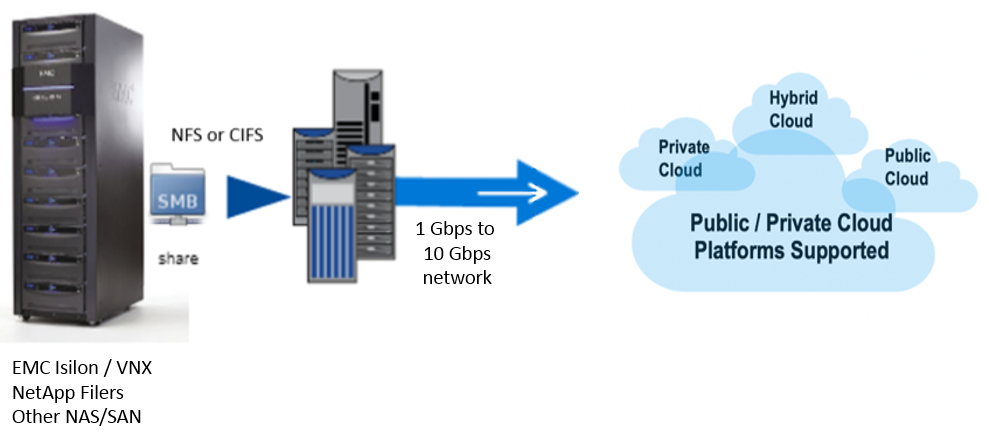
SoftNAS Lift and Shift feature continuously syncs data from the source NFS or CIFS mount points with the SoftNAS storage volumes hosted in the cloud, as shown below. Data migration over the wire is convenient for migration projects where data is constantly changing in production. It keeps both sides in sync throughout the workload migration process, making it faster and easier to move applications and dependencies from on-premises VM’s and servers into their new cloud-based counterparts.

In other cases, there could be petabytes of data that need to be migrated, much of that data being inactive data, archives, backups, etc. For large-scale migrations, the cloud vendors provide what we historically called “swing gear” — portable storage boxes designed to be loaded up with data, then shipped from one data center to another — in this case, it’s shipped to one of the hyper-scale cloud vendor’s regional datacenters, where the data gets loaded into the customer’s account. For example, AWS provides its Snowball appliance and Microsoft provides Azure DataBox for swing gear.
If the swing gear path is chosen, the data lands in the customer account in object storage (e.g., AWS S3 or Azure Blobs). Once loaded into the cloud, the SoftNAS team assists customers by bulk loading it into appropriate SoftNAS storage pools and volumes. Sometimes customers keep the same overall volume and directory structure — other times this is viewed as an opportunity to do some badly overdue reorganization and optimization.
Why Customers Choose SoftNAS vs. Alternatives
SoftNAS provides an ideal choice for the customer who is looking to host data in the public cloud in that it delivers the most cost-effective storage management available. SoftNAS is able to deliver the lowest costs for many reasons, including:
- No Storage Tax — Buurst SoftNAS does not charge for your storage capacity. You read that right. You get unlimited storage capacity and only pay for additional performance.
- Unique Storage Block Tiering — SoftNAS provides multi-level, automatic block tiering that balances peak performance on NVMe and SSD tiers, coupled with low-cost bulk storage for inactive or lazy data in HDD block storage.
- Superior Storage Efficiencies — SoftNAS includes data compression and data deduplication, reducing the actual amount of cloud block storage required to host your file data.
The net result is customers save up to 80% on their cloud storage bills by leveraging SoftNAS’s advanced cost savings features, coupled with unlimited data capacity.
Summary and Next Steps
Isilon is a popular, premises-based file server that has served customers well for many years. VNX is the end of life. NetApp 7-mode appliances are long in the tooth with the end of full NetApp 7-mode support on 31 December 2020 (6 months from this posting). Customers running other traditional NAS appliances from IBM®, HP, Quantum, and others are in similar situations.
Since 2013, as the company that created the Cloud NAS category, Buurst SoftNAS has helped migrate thousands of workloads and petabytes of data from on-premises NAS filers of every kind across 39 countries globally. So you can be confident that you’re in good company with the cloud data performance experts at Buurst guiding your way and migrating your data and workloads into the cloud.
To learn more, register for a Free Consultation with one of our cloud experts. To get a free cost estimate or schedule a free cloud migration assessment, please contact the Buurst team.
Check Also:
Why Azure SoftNAS over NetApp Files?
Consolidating EMC VNX File Servers in the Cloud.
Isilon Disaster Recovery
Comments
Post a Comment